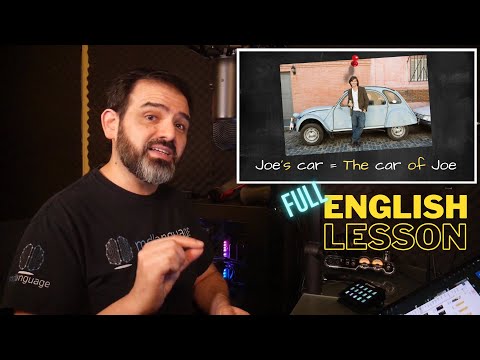
The Possessive 's in English
In English, the most natural way to show that something belongs to someone is to add 's to the owner: "This is Anna's bag" and "The cat's eyes are green." English speakers use this far more than the "of" structure, so we say Anna's bag, not "the bag of Anna." When the owner is a plural noun already ending in -s, you add only an apostrophe, with no extra s: "My friends' car." Watch the apostrophe carefully, because "the dog's tail" (one dog) and "the dogs' tails" (many dogs) mean different things.
Examples
- This is Anna's bag. the bag belongs to Anna
- The cat's eyes are green. the eyes of the cat are green
- My friends' car the car belonging to my friends
The full lesson
Everything in the video, in text.
-
In English we almost never say the car of Tom. We say: Tom's car. That tiny apostrophe-s does all the work.
-
Most languages link an owner to a thing with a word like of. English usually does the opposite: it sticks the owner in front and adds apostrophe-s. Let's learn exactly how.
-
The core rule is simple. To show that something belongs to a person or an animal, add apostrophe-s to the owner's name.
-
There's just one branch to remember. A single owner takes apostrophe-s. A plural owner that already ends in -s takes only an apostrophe. Keep that split in mind.
-
Start simple. One person, one thing. This is Anna's bag. The bag belongs to Anna.
-
It works for animals too — they're owners just like people. The cat's eyes are green. The eyes of the cat.
-
And notice it can hold a whole phrase, not just one word. My brother's friend is here. One brother, so apostrophe-s.
-
Now the plural side. When the owner is plural and already ends in -s, you don't add another s — you just add an apostrophe after it.
-
Two parents own the house, so the apostrophe lands after the s. This is my parents house. The house belonging to both my parents.
-
Same idea with friends. My friends car is fast. The car belongs to several friends.
-
One nuance worth knowing: some plurals don't end in -s, like children. Those go back to the normal apostrophe-s. The children's toys are everywhere.
-
Here's the biggest trap for learners. Don't borrow the of structure from your language for people. Not the car of Tom — Tom's car.
-
And don't drop or misplace the apostrophe. Toms with no apostrophe is just wrong, and the apostrophe's position even tells you how many owners there are.
-
So, to recap: put the owner first, add apostrophe-s for one owner, and just an apostrophe for a plural owner ending in -s.